Recently, the well-known domestic benchmarking platform AnTuTu released the first Android phone performance ranking for January 2020, covering the mainstream popular models currently on the market. Since the latest Qualcomm Snapdragon 865 chip flagship phones are all in a pending release state, the most obvious highlight on this ranking is: the PK comparison between Qualcomm Snapdragon 855 models and Kirin 990 5G models.
From the results, the benchmark data of the Kirin 990 5G chip still cannot beat the Qualcomm Snapdragon 855. The first and second places are both Vivo's sub-brand IQOO. Whether it is the IQOO Neo 855 Racing Edition or the IQOO Pro 5G, both are equipped with the overclocked Qualcomm Snapdragon 855 Plus chip, with benchmark scores exceeding 500,000 points.
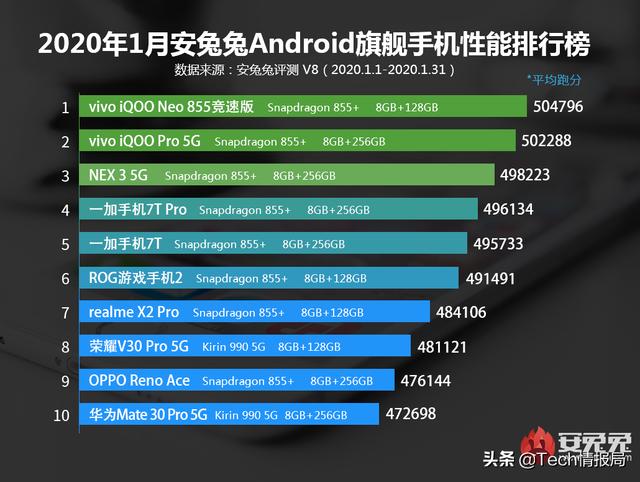
In third place is the Vivo NEX3 5G, followed in order by the OnePlus 7T Pro, OnePlus 7T, ASUS ROG Gaming Phone 2, realme X2 Pro, Honor V30 Pro 5G, OPPO Reno Ace, and Huawei Mate30 Pro 5G. Unfortunately, the Huawei Mate30 Pro 5G ended up at the bottom with 470,000 points, more than 10,000 points lower than its sibling Honor.
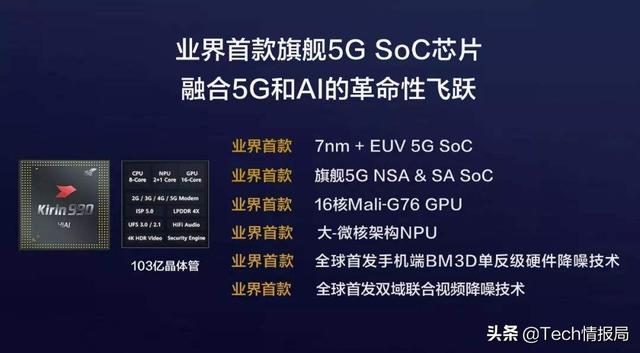
From this ranking, we can also see that the current benchmark performance of the Kirin 990 5G chip is indeed behind the Qualcomm Snapdragon 855 Plus version, with a data gap of nearly 30,000 points. The gap is not large. If it were reflected in actual use, I believe many people would find it hard to notice. After all, the performance of the vast majority of smartphones today is already excessive.
In addition, AnTuTu also released another January Android phone performance ranking, but it mainly compares mid-range phones. The results show that the latest OPPO Reno3 5G equipped with MediaTek Dimensity 1000L has the highest benchmark score, reaching 390,000 points. The Vivo X30 Pro 5G equipped with the Samsung Exynos 980 chip is second, with a benchmark score of 320,000, while the Redmi K30 5G representing the Qualcomm Snapdragon 765G chip also scores 320,000, and the Honor 9X Pro using the Huawei Kirin 810 chip scores 310,000.
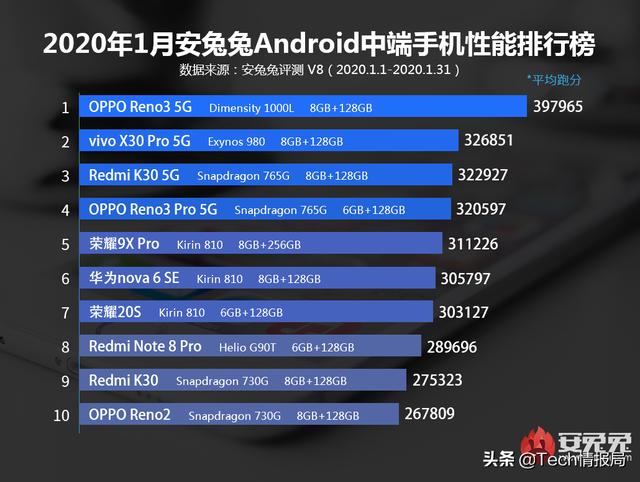
It must be said that the MediaTek Dimensity 1000L chip is truly cost-effective. In the mid-range phone camp, its performance stands out among the crowd, greatly leading other chips, with a benchmark gap of nearly 80,000 points. Moreover, it also supports SA/NSA dual-mode 5G, making it the best choice for 5G mid-range phones this year.
Finally, with the release of the Qualcomm Snapdragon 865 flagship chip in February, I wonder what changes will appear in the performance ranking?

Room 1409, Building C, Shenzhen Century Industrial Center, No. 743 Zhoushi Road, Hezhou Community, Hangcheng Sub-district, Bao'an District, Shenzhen