Why Are Many Companies Still Inefficient After Implementing ERP, MES, and Other Systems? 3 Major Challenges in Enterprise Digitalization
Why Are Many Companies Still Inefficient After Implementing ERP, MES, and Other Systems? 3 Major Challenges in Enterprise Digitalization
Published: 2021-08-16 20:29 Source: 向明科技
Starting from every piece of steel in the Eiffel Tower
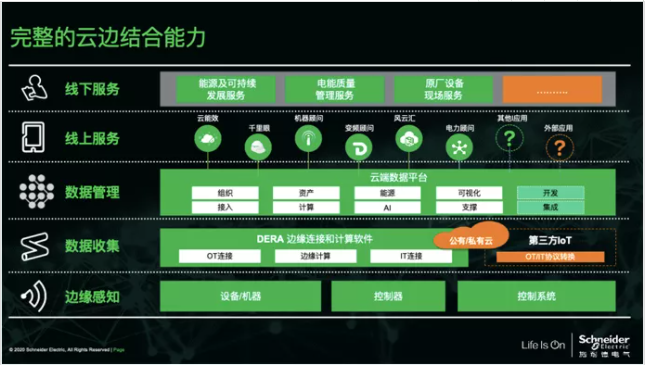
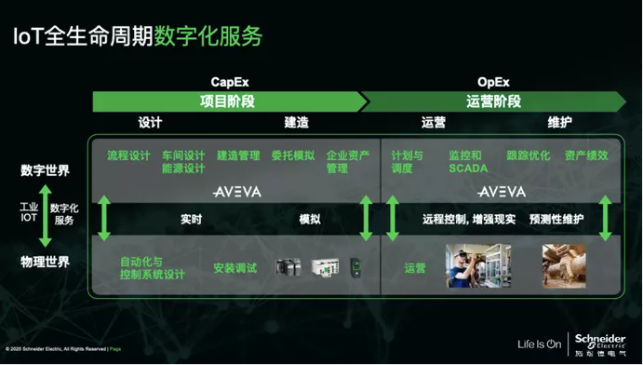
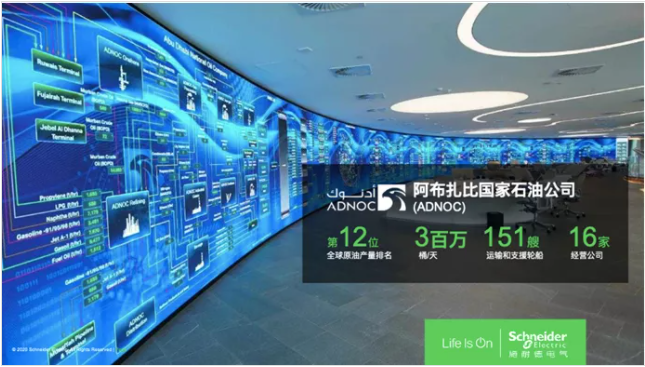
The digital transformation of traditional manufacturing is a very big topic. I will start withthe three security guard questionsto begin today's explanation:Who are you? Where do you come from? Where are you going?Schneider Electric has a history of 184 years, and itself hasslowly transformed from a very traditional manufacturing company.We started out making steel,every piece of steel on the Eiffel Tower in Paris was made by Schneider Electric; at the most glorious time of the industrial revolution, we gradually shifted to electricity; in the 1970s, we gradually clarified two major areas, one is energy management, and the other is automation; now in the so-called third industrial revolution, through digital empowerment, we truly combine the energy fieldwith automation to improve efficiency and generate more potential. According to the shift of the industrial revolution, we adjusted our industry and went international, and now our revenue in North America, Asia, and Europe is equally large. In terms of intelligence in industrial manufacturing,Schneider Electric has 200 factories and 98 logistics centers worldwide.When it comes to the entire IOT (Internet of Things), it is nothing more than three levels: ● The first level is interconnection at the physical level;● The second level is the automation, visualization, and scalability of data collection;● The third level is the analysis, judgment, and application of data.Everyone thinks IOT sounds very simple, but what is truly difficult is the combination of IT and OT, because the needs of each industry are completely different, and the needs of different process sections are also different. So how to combine the two well is fundamental. This is also what Schneider Electric has always been doing.In this era there are several major trends that have a very large impact on every person, every country, and every region.The first is the energy transformation.Factories want to go digital, and their demand for energy will at least double. But we only have one Earth, so energy efficiency must increase by 50%, so that in the next 20 or 50 years, total energy consumption will be the same as today.First is electrification. The growth of primary energy is not fast now, because in the past we used more oil resources, but now electricity use is actually growing very fast. For example, in the past cooking used gas, but now cooking uses rice cookers and microwave ovens; in fact, these same energy sources are still being used, it is just that you use more electricity. What is the benefit of first converting fossil energy into electricity? Because electricity is closer to digitalization and easier to control than gas, coal, and gas.Moreover, coal-fired power generation causes the greenhouse effect. So we must reduce carbon content starting from primary energy. For example, using renewable energy such as hydropower, wind power, solar power, etc., and now there are also more technologies working on how to capture carbon back. Reducing carbon content across the entire energy system is the most fundamental thing.The second is digitalization.Now how to link machines and people, and do a good job in the interaction between machines and people, and between people and people. There is a bit too much data now, but having data alone is useless if you do not understand the profession. The ultimate goal of artificial intelligence is also the combination of technology and professional fields.The combination of the entire energy and digitalization,is actually the most fundamental technological driver brought by IOT, and at the same time the greatest demand of the entire society.| The absolute winner during the pandemic: digitalizationNow China has basically come out of the pandemic. What problems did we encounter at that time?First, what to do when resuming work?At this time, the resilience of the enterprise's business is very important. With so much equipment remotely located and people unable to go there, is there a way to know how the equipment is working? For customers at the remote end, is there a way to support them?Second, the pandemic brought about a particularly interesting thing, which is that the world is not very synchronized.In the past, any crisis made the world relatively synchronized.But when the pandemic was severe in China in February, Europe and the United States actually had a very good economy; and when China resumed work, Europe and the United States entered the peak period of the pandemic. This is a very terrible thing for the supply chain.The original supply chain model was a globalized division of labor, with global trade products jointly produced by dozens or even hundreds of enterprises distributed in different countries, and tens of thousands of production nodes connected and circulated through the global supply chain. If not synchronized, this line is actually broken. This is the moment that tests the enterprise's supply chain capability.Previously we had always been talking about consumption upgrading, but after the pandemic it became consumption downgrading. When meeting customers, the first thing they say is cost reduction. Because it is not easy for everyone to make money now, the first thing in doing business is definitely to ask whether you can lower the price. Improving enterprise efficiency is very important at this time.Third, although this round of change was caused by a virus, it may also be a warning from the Earth to humanity.Because the outbreak of the virus is related to the population explosion. If there are not many people in a place, it cannot spread. So to restore the economy, we must think about how to make it greener and more sustainable.Right now many people only say they want to seize back the lost time. But everyone may not have reflected on this matter. The EU this time spent almost 10% of GDP on stimulus, hoping that the economy will come back in a greener way. This is a very good idea.This is very similar to our country's policies. In manufacturing, the first thing is compliance, because environmental protection requirements in all aspects are getting higher and higher. Second, energy consumption is directly a cost. With the same output, if you reduce energy by 5%, your cost expenditure is reduced by 5%. At this time, digitalization will bring many benefits.But digitalization is not a panacea; digitalization is a tool, and the key is for managers and employees to use this tool well together.Digital transformationTrends, challenges, and measuresFor digital transformation in manufacturing, the first thing is to understand four integrations. Because everything we do is ultimately to improve efficiency, these four integrations are meant to solve the efficiency problem.| Four-dimensional integrationThe first is the integration of energy management and automation Take China as an example. In the past, energy was produced centrally, with a huge mine-mouth power station or nuclear power station generating electricity centrally, and then transmitting it to various places through a large power grid. This was a very planned-economy idea.Now there is new energy. First, new energy shows a distributed trend. Although there are centralized wind farms and photovoltaic farms, more often there is a wind turbine here and a few tiles there, including solar panels placed on the rooftops of many factories.Second, wind power, photovoltaics, and hydropower depend on the weather. For example, when a cloud comes, the efficiency of the entire photovoltaic farm will be different.At this time, a big problem arises: when there is no storage technology, electricity is generated and used immediately, which creates an imbalance between the demand side and the supply side.So this requires the entire energy management to shift more from centralized to decentralized.This is the same as data centers. In the past, data centers were also a very centralized approach, but now edge computing is increasingly adopted. Although there are still centralized ones, much computing can be done at the edge. For example, everyone's smartphone itself is a computer, and its computing power may be greater than that of a data room from years ago. Whether it is energy or automation, both are in a change from decentralized to centralized and then to distributed. So the combination of the two is very important.The second is the vertical integration from terminals to the cloudThis is the interconnection at the physical layer, to the automation and visualization of data collection, and then to digital services for the entire analysis. I have made a display diagram here.First, there is edge perception, including your control systems and equipment. Under different circumstances, you collect data, and you can use the public cloud, or you can use a private cloud at the edge. The most important thing is data management and analysis, and how to integrate data from different sources.Once you have these things, you can provide both remote services and offline services. In fact, there is also the concept of O2O in digitalization.The third is the horizontal integration of the entire life cycleAny process has a life cycle,A factory goes from process design, then construction, to operation and maintenance, which is a life cycle. Equipment also goes from design and manufacturing, to initial use, to maintenance and retirement, which is also a life cycle.In fact, it is just like people. A new piece of equipment is like a young man who has no illness, and even if he is ill, he does not go to see a doctor. But if you do not maintain it well, originally a piece of equipment has a 20-year lifespan. Inside the equipment there are wearing parts and non-wearing parts. If a wearing part breaks and should be replaced but is not, it may make the lifespan of the entire workshop's equipment uneconomical. So at this time you can extend its life.In the past, the convention was that one group of people did design, one group did manufacturing, one group did delivery, and one group did operations, and the data were all on paper. From design to manufacturing there were many changes, and the machine status during operations was different again. These data were not superimposed on the original data, so there was no way to form a closed loop.Now there is a new concept called the digital twin [Digital twin: A digital twin is a simulation process that fully utilizes physical models, sensor updates, operating history, and other data, integrates multidisciplinary, multi-physical, multi-scale, and multi-probability factors, and completes mapping in virtual space, thereby reflecting the entire life cycle process of the corresponding physical equipment.]Starting from the initial process design, a digital file is created, and then during the design and construction process this electronic document is continuously modified, until during operations a large amount of operational data can be superimposed on the original design document.The same is true for the maintenance of the entire equipment. From the start of equipment use, to the equipment's historical situation, maintenance situation, and current status, predictive maintenance is done. Because if the equipment breaks down, the whole business is gone.As everyone knows, especially for continuous processes, it is necessary to find the right time point for maintenance, so it is necessary to understand how to do digital twins for the entire manufacturing life cycle. This is the foundation for future efficiency improvements in manufacturing.The last one is from decentralized management to integrated enterprise managementIn the past, when enterprises were small, the boss was usually a technical expert and marketing expert, and could see everyone below him, and also knew the few customers. When you grow bigger, the enterprise has 1,000 people, 10,000 people; originally there was only 1 workshop, now there are 5 workshops, and gradually it becomes 5 factories distributed in 5 places.At this time, relying on personal experience and people for management definitely will not work. How can all this information be integrated and connected?For example, Abu Dhabi National Oil Company has a daily oil production of more than 3 million barrels, 150 ships, and 16 subsidiaries under it. So we made a large full screen three meters high and more than ten meters long for it, integrating all information together, with more than 100,000 points and more than 2 million pieces of data.| Three major challengesThe first challenge is certainly in management. In fact, the most fundamental thing is still strategy.First, you must understand what your strategic goal is. Some enterprises produce relatively single products in large batches, while others customize in small batches. We just mentioned that there are continuous processes and also discrete manufacturing. If you make small-batch customized products, then going in for large-scale automation may not necessarily be the best solution.After strategy comes culture. Many times when manufacturing is doing digitalization, employees feel that this is a matter for the IT department, the informatization department, or the automation department, and has nothing to do with them. Without the participation of frontline employees, digitalization cannot be done. Because the entire digital transformation is a gradual process, not as simple as replacing people with automated equipment.Before digitalization, enterprises conventionally used relatively simple KPIs for management, which was rather rigid. To do digitalization, it is necessary to relatively increase the tolerance of the organization, allow everyone to trial and error, and allow cross-border cooperation. If the corporate culture divides KPIs very finely, no one is willing to trial and error or innovate.The previous organizational structure was basically business divisions, and each department was its own little world, reporting things up layer by layer, and then assigning tasks down layer by layer. In the future, organizations must first be flattened, because with data, so many people in the middle are not needed to summarize. We can liberate this manpower to do more creative things.Now many companies have implemented various systems such as ERP and MES, but the systems are surprisingly not connected to one another. They originally wanted to do digitalization, but the result was a Qiandao Lake. The water in each lake is indeed quite abundant, but it sits there silted up and inefficient. So this problem also must be solved. This is again closely related to the earlier organization, culture, and strategy. The system is a mapping of your organizational culture. If these problems are not solved, digitalization will ultimately create more Qiandao Lakes.The second is the capability challengeFirst, let's talk about the human aspect. Previously it was said that each profession has its own specialty, but now what is needed more is relatively cross-disciplinary ability, because what we are doing now is different from the original perspective. This is also related to the company's direction and thinking on how to cultivate people, and how to build a learning organization and encourage employees to learn, because stones from other mountains can polish jade.Many manufacturing enterprises have been reducing staff and increasing efficiency for a long time, resulting in no young people within the organization. How can more young people be attracted to join manufacturing? Friction among the old, middle-aged, and young will bring different sparks.After the combination of IT and OT, there can be different extended requirements for the company's technology. First, communication technology capabilities must be improved. Of course, you do not need to know how to produce 5G products, but you need to plan how to interconnect and communicate within the factory. You can also ask a professional company to help with this, but you need to have awareness and ideas in this area.The second is the requirement for data collection and analysis capabilities. Now it's not that there's too little data, but too much data, and with so many Qiandao Lakes, we need the ability to better use data. Everyone suddenly realized that many manufacturing companies now have data engineers.The third is the reengineering of the entire process. If your company is large, how can you recombine these things? So you need integrated data processing and process capabilities.For the third point, digitalization really needs to succeed, and benefits must come first. Everyone thinks social benefits and economic benefits conflict, but I think they don't conflict at all.Factories are required to reduce energy consumption by 5% each year. At first it's easy, you just need to turn off one of the two rows of lights in the corridor. After two or three years it doesn't work anymore, and this forces you to think about how to do lean management. Only by knowing where every kilowatt-hour and every unit of energy is used, and where it can be saved, can you continue energy saving. In this way your management benefits improve, and there will definitely be economic benefits. At the same time, saving electricity and energy, how can there be no social benefits?For the entire manufacturing enterprise, don't worry about the imbalance between social benefits and economic benefits. I think as long as you understand economic benefits and don't do anything illegal, it will definitely be balanced.| Two Major MeasuresThe solution is also very simple. First, grasp management and reform corporate culture, but this is a gradual process. Organizational flexibility must change to better adapt to changes. Finally, your processes must be reengineered. Never just map existing processes with code into digital space, that would be terrible.Second, improve capabilities. Figure out what capabilities to build, which to build first, which to build later, and which can be outsourced. Next, attract talent, and the key is to enable existing talent to learn new things as well.
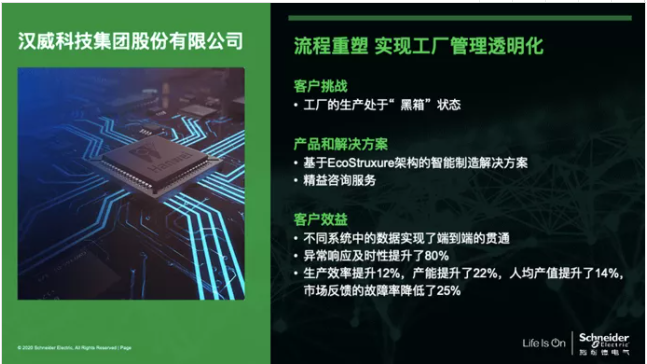
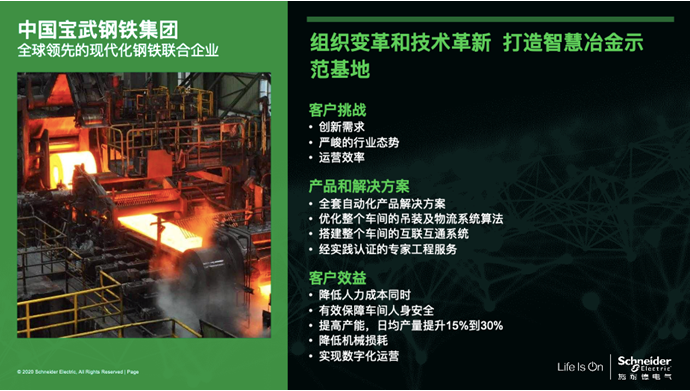
Examples of Digital Transformation in Light and Heavy IndustryNext I will use several cases to illustrate the integration of the four dimensions and the three major challenges mentioned above. One is a discrete industry, light industry, with relatively low energy consumption and relatively small scale;the other is a heavy industry, continuous process, with a very large scale enterprise.Hanwei ElectronicsHanwei Electronics is a company that makes sensors. The characteristics of this industry are many categories, very small orders, sometimes just one or two items in an order.This company suddenly found that it could no longer grow because it had exceeded the limits of management. It promised customers delivery times, such as a certain number of days, but it never knew whether it actually achieved them, because sometimes customers were not so strict. But it found that employees were working overtime in the factory every day, and efficiency was very low.First diagnose, then prescribe,We first did a diagnosis for it. The main issue was that management was a black box, but it didn't know how to break the black box. The foundation of management is to clarify goals, and you must not blindly install equipment first.Second, software first, hardware later, first connect the information, then consider hardware issues. When information is not connected, the more hardware you install, the more serious the information blockage or mismatch becomes.In order to connect information, they added electronic scanning guns and moved the original drawings to electronic whiteboards. Previously problems were scattered Qiandao Lakes, and it might take a month for each team's problems to reach the general manager's office. Now everyone can see problems within a few hours, and even solve them at the team level and production line level.Third, small steps and quick runs, solving problems bit by bit.As an enterprise, you can't let everyone stop and do nothing but solve problems. That's unrealistic.We helped it make lean changes to the entire production process route, such as changing long lines to short lines, and short lines to U-shaped lines. Combining the two, efficiency immediately improved. In the same factory building, capacity suddenly increased by 22%, and output per capita increased by 14%. We calculated that the investment payback period was recovered in half a year, so its enthusiasm was very high and it kept pushing this forward.So diagnose first, then prescribe; software first, hardware later; small steps and quick runs.BaosteelBaosteel's 1580 workshop is a pilot for intelligent manufacturing by the Ministry of Industry and Information Technology. It is a hot rolling workshop and hopes to achieve unmanned cranes. "Crane" is a common term people use for hoists, traveling cranes, overhead cranes, and other lifting equipment, basically the same as what we call cranes. Previously, people sat on cranes to grab the slabs.Its management objectives are relatively clear. First, safety. Because this kind of work is very intense, if a person is slightly careless, it is very easy to have a safety accident, so they hope to reduce people. Second, accuracy. Previously where the slabs were hung depended entirely on people's memory, so the accuracy rate was always only around 30%.This transformation has very high technical requirements. First, it must be unmanned. Second, operating such a large workshop involves many obstacles in between, requiring artificial intelligence to partially identify obstacles. Third, it must have memory function to find slabs in time and improve accuracy.We cooperated with Baosteel, combining IT technology with our understanding of OT, to create a real-time online fully unmanned intelligent system.After completion, 20 workers were saved. It's not just saving money, but more importantly safety. Second, its accuracy rate reached over 90%, and output immediately improved, bringing economic benefits.So for heavy industry, once you understand management needs, think through process design, and then integrate technology, you can achieve very good results.SummaryFor manufacturing enterprises to do digital transformation, they must diagnose first, then prescribe; software first, hardware later; small steps and quick runs; benefits first. In terms of measures, it must start with management, capabilities, and benefits.Back to today, every year seems harder than the previous year. But there are also many enterprises that combine these capabilities better, and in fact their business becomes more resilient. They have better control over customers than competitors, and better matching with upstream supply chains and downstream transportation. In this way, in a rapidly changing world, you may have more opportunities.Benefits come from efficiency. To make money, you must improve efficiency.At the same time, compliance also brings social benefits, so it will be more sustainable.Sustainability does not only refer to gold and silver mountains. Digital transformation is a gradual process.Sometimes top-down, sometimes bottom-up, it slowly spreads from a pilot, a continuous iterative process from 0 to 1 and from 1 to N.Schneider Electric's transformation over the past 184 years has also been walked step by step like this. It looks very long, a very arduous process, and also a process of self-revolution.Once you have a culture of continuous transformation, a belief and capability, then in dealing with the entire changing world, changing competitive landscape, and changing customers, you will stand in an unchanging and undefeated position.