E-commerce is not just limited to C2C, B2C, and B2B. The author of this article has reviewed and summarized 10 relatively mature e-commerce models, and introduced their corresponding business processes, profit models, and the business logic behind them. Sharing with everyone.

When it comes to the word "e-commerce," there is indeed so much to write about that I don't know where to start. To better meet readers' needs, the author spent 2 weeks sorting out 10 relatively mature e-commerce models to date. This article will share their business processes, profit models, and the business logic behind them one by one.
(Note: Due to the diversity of e-commerce businesses, the classification standards in this article are not 100% rigorous, so the same e-commerce platform may be classified under different categories.)
This article is suitable for product managers, because it involves the business logic of some products; it is also suitable for product operations, because you need even more to find a monetization model that suits you better.
When most people mention e-commerce models, they may immediately think of C2C, B2C, B2B, and so on, but it is already 2020, and various new e-commerce models are emerging one after another. It is somewhat narrow to still divide them this way. Therefore, this article will take into account traditional e-commerce models while focusing on introducingnew or relatively nichee-commerce models.
1. Traditional e-commerce
At present, there is no separate definition in the industry. Before Pinduoduo, the widely known e-commerce giants basically all belonged to the category of traditional e-commerce. This type of e-commerce platform generally was established early, is large in scale, and has high visibility, such asTaobao/Tmall, JD.com, Suning, Vipshopand so on. Under this model, new e-commerce platforms includeNetEase Kaola, NetEase Yanxuan, Secoo, Xiaomi Youpinand others.
Traditional e-commerce integrates retail, marketing, logistics, finance, and other business forms to form a supply-side network synergy effect, thereby improving the efficiency of the entire organization and further sharing service costs.
Taking JD.com as an example, JD Mall was upgraded to a retail sub-group, forming the "three carriages" together with JD Logistics and JD Digits, creating a full business process closed loop of retail + logistics + finance. This is also the development direction of most traditional comprehensive e-commerce in the future.
This part is suitable for in-depth study by practitioners in the e-commerce industry. Later, the author will elaborate in combination with work experience at JD.
2. Social e-commerce
In the past 2019,"social e-commerce"became popular across the country and also attracted widespread attention in the industry. According to incomplete statistics from Ebrun, in the first half of 2019 alone, 17 social e-commerce financing events occurred, with a total amount of more than RMB 2 billion.
Unlike traditional e-commerce, social e-commerce focuses on consumers' interpersonal relationships, generating aggregation benefits based on sharing and fission between people, and in turn reducing the platform's customer acquisition costs and service costs.
At present, the mainstream social e-commerce models include the following four types:
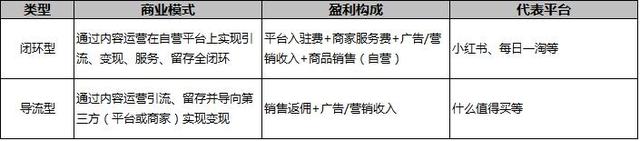
1. Social content e-commerce
Under this model, the platform relies on high-quality content to guide value-based consumer decision-making. According to whether the platform's products are self-operated, it can be divided into 2 categories. The specific business model and profit composition are shown in the table below:
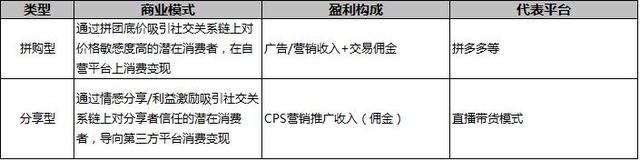
2. Social sharing e-commerce
Under this model, the platform relies on social relationship chains to promote user fission and product dissemination. According to whether the platform's products are self-operated, it can also be divided into 2 categories. The specific business model and profit composition are shown in the table below:
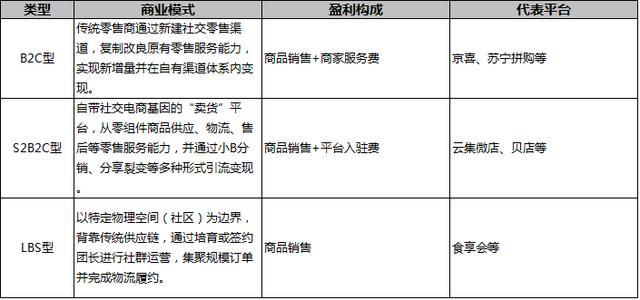
3. Social retail e-commerce
Under this model, e-commerce platforms rely on retail capabilities to promote stock optimization and incremental mining. According to the classification method of traditional e-commerce, it is divided into the following 3 categories. The specific business model and profit composition are shown in the table below:
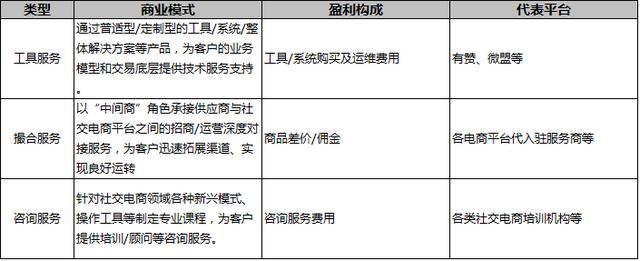
4. Social e-commerce service providers
Under this model, the platform relies on professional services based on big data and new technologies to empower all links of social e-commerce. According to the types of services provided, it can be divided into the following 3 categories:
3. Fresh food e-commerce
Fresh food e-commerce refers to the use of e-commerce means to directly sell fresh products online, such as fresh fruits, vegetables, fresh meat, and so on. This year, affected by the pandemic, the fresh food e-commerce industry broke out strongly. The relevant data is elaborated in detail in the author's article "Several Thoughts on the E-commerce Industry Under the Pandemic" and will not be repeated here. Competition in this track is still white-hot, with platforms such as Hema, MissFresh, Dingdong Maicai, and Meituan Maicai each showing their own strengths.
The main profit model of fresh food e-commerce is thefront warehouse model, and the front warehouse model refers to a smaller warehousing unit closer to consumers, generally set up near communities where consumers are concentrated. Its operating model is: the seller of fresh products uses cold chain logistics (refrigerated trucks) to deliver products in advance to the front warehouse for storage and sale. After the customer places an order, the front warehouse operator organizes the completion of package production and "last mile" door-to-door delivery. Whether in terms of order response speed or delivery cost, the front warehouse model has great advantages compared with direct delivery.
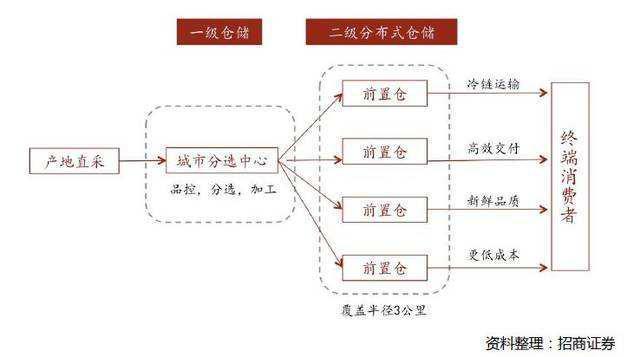
Figure: Front warehouse model diagram, image source: China Merchants Securities
4. Maternal and infant e-commerce
As the name suggests, maternal and infant e-commerce refers to vertical e-commerce platforms whose main business categories are maternal and infant products and related services.
Affected by the opening of the "second-child" policy, the entire maternal and infant market has "tasted" the related dividends. For example, childcare workers, maternity matrons, maternal and infant stores, children's playgrounds, and so on are all growing rapidly, and some have even become in short supply. The maternal and infant e-commerce industry has also enjoyed the "second-child" dividend. According to the "2019 China Internet Maternal and Infant Market Research Report" released by the data research institution BigData-Research (Bida Consulting), the number of users of China's mobile maternal and infant platforms reached 200 million in 2019, an increase of nearly 30% compared with 2018. At present, maternal and infant e-commerce takes online self-operated maternal and infant products as the core and has the following four industry models:
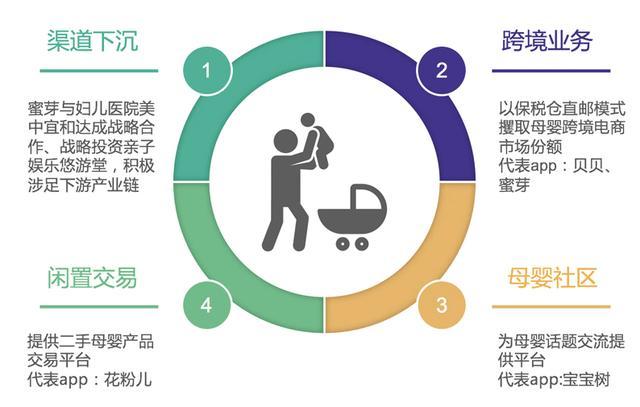
Among them, among the major Internet maternal and infant platforms in 2019, those committed to building "large parenting website communities"BabytreeWith the largest user base, its Babytree Pregnancy App is most popular among post-90s expectant mothers, becoming the first entry point for pregnant users, with the highest user satisfaction.
Public data shows that as of the end of February 2020, the number of creators on the Babytree platform was 159,000, including over 20,000 KOCs and KOLs with huge potential, and high-quality content created by KOCs reached 1 billion views on the Babytree platform.
V. Pet E-commerce
According to the 'Social E-commerce Pet Industry Report' released by the Pet Industry White Paper in collaboration with SaaS provider Youzan, from 2018 to 2019, the number of pet owners in China grew from 73.55 million to 99.15 million. In 2019, the consumption scale of pets (dogs and cats) in China reached 202.4 billion yuan, a month-on-month increase of 18.5%, of which 53.2% of consumption occurred online (107.7 billion).
Therefore, pet e-commerce hasa market scale of hundreds of billions, withePet MallandBoqii Petas representatives, vertical pet e-commerce platforms are flourishing.
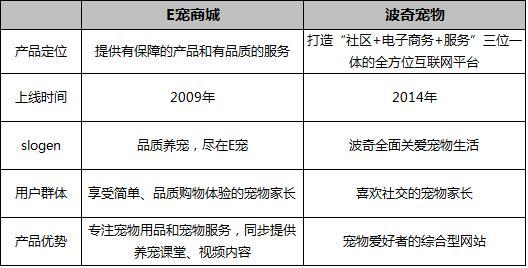
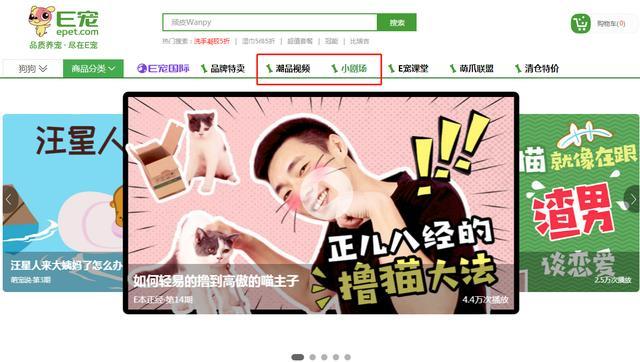
From the current product form, ePet Mall is comprehensively laying outUGCandPGCcontent shopping guide modules. The author believes it will better fit the shopping habits of the new generation of pet parents, thereby achieving better development.
VI. Vertical Flash Sales
Objectively speaking, the earlyZhe800 and Juanpi.comcould be considered true vertical flash sale platforms, but with the popularity of PDD and the general improvement of people's living standards, pure low-price flash sale websites like Zhe800/Juanpi have lacked vitality. Today we focus on the C2M reverse customization platform that focuses on 'big brand quality, factory price'——BiYao。
BiYao is the world's first e-commerce platform for user-to-manufacturer (C2M) direct connection. It adopts the C2M model to achieve a two-point direct connection from users to factories, removing all intermediate circulation links, connecting top designers and top manufacturers, and providing users with top quality, affordable prices, and personalized exclusive products. According to its value proposition, it can be seen that BiYao Mall only provides users with 'low price', 'high quality', and 'exclusive' products. The main profit model isa 7% sales commission, maximizing product cost-effectiveness.

VII. Shopping Guide E-commerce
Disclaimer in advance:This part is not recommended for everyone to try, and I am not an upstream promoter.
Such platforms generally follow the theory of CPS sales, importing third-party platform products upward through API interfaces, and developing member customers downward in a distribution model (some involve member grading). The profit models mainly include: ① commission difference; ② membership fees; ③ gross profit from some self-operated products.
Currently, the relatively mature platform in the industry isHuasheshengji, and the ones with strong development momentum areTaoxiaopuandFenxiang。
Among them, Huasheshengji is a comprehensive shopping guide platform, Taoxiaopu focuses on Alibaba system products (strongly integrated with Taobao), and Fenxiang focuses on JD system products (strongly integrated with JD + WeChat).
Friendly reminder, this model's fission effect isvery scary, please readers do not test it easily.
VIII. Cross-border E-commerce
According to the '2018 China Cross-border E-commerce Market Data Monitoring Report', in 2018, China's cross-border e-commerce transaction scale reached 9 trillion yuan, a year-on-year increase of 11.6%. Among them, exports accounted for 78.9%, and imports accounted for 21.1%.
Currently, apart from leading e-commerce companies, those doing relatively well in the export sector includeshopee、Akulaku、Lazadaetc. The operating model of this type of e-commerce can actually fully reference the operational strategies of mainstream domestic e-commerce (store groups or refined operations), while combining with the user habits of the site where it operates; the import sector is mainly concentrated in leading e-commerce platforms, such asTmall Global, JD Worldwide, NetEase Kaolaetc., while in vertical sectorsYangmatouis doing quite well.
Taking Yangmatou as an example,"buyer merchant system"is its core advantage. Yangmatou focuses on globalized products, covering 800,000 different products from 83 countries and regions, and has up to 60,000 professional buyers, among whom there are quite a few internet celebrities and professional buyers. These people all provide a better carrier for Yangmatou to achieve globally personalized consumer recommendations, and are also an important backing for safeguarding the quality of product sources and enhancing the overseas shopping experience.
9. Mini-program e-commerce
After WeChat's father Zhang Xiaolong officially announced that mini-programs would officially launch on January 9, 2017, e-commerce models based on the mini-program ecosystem have emerged one after another. There is no need to mention leading PDD, JD, and others with their own traffic; we will focus on discussing "focusing on WeChat product-effect marketing"Xiaodianpu。
This platform calls itself "the largest mini-program e-commerce service platform in the WeChat ecosystem," connecting upward to 1000+ brands and 100,000+ SKUs, and developing downward 3000+ self-media, with over 1 billion+ daily PV.
In addition, worthy of attention is the newly launched "Tencent Smart Retail" mini-program this year. As a decentralized traffic distribution platform + private domain traffic diversion platform, and also possessing LBS-based product capabilities, Tencent Smart Retail has a very large space for imagination in the future.
10. Tail goods distribution model
This model is completely different from the seventh guide-shopping model. Tail goods distribution refers to providing brand product distribution capabilities only to B-end or small B customers, similar to Alibaba. Currently, those doing relatively well include the one that focuses on "preferred choice for brand distributors"Aikucun。
Its operating model is to recruit brand merchants upward, with brand merchants providing products (discounted tail goods) and logistics services, and to recruit distributors downward for a fee (only level 1). The platform is responsible for guiding distributor operations, and distributors are responsible for sales. The platform and distributors distribute the product price difference according to a certain proportion.

Room 1409, Building C, Shenzhen Century Industrial Center, No. 743 Zhoushi Road, Hezhou Community, Hangcheng Sub-district, Bao'an District, Shenzhen