On March 31, according to a CCTV News report, with the approval of the CPC Central Committee and the State Council, the 2020 national unified examination for admissions to general higher education institutions will be postponed for one month and held on July 7 and 8. Hubei Province and Beijing may, based on the situation of epidemic prevention and control, study and put forward opinions on the scheduling of the college entrance examination in their regions, and after obtaining the consent of the Ministry of Education, release them to the public in a timely manner.
Affected by the COVID-19 epidemic, schools across China have postponed the start of the semester, and off-campus training institutions have also stopped offline training. Meanwhile, high school seniors, "born during SARS and taking the exam during COVID-19," are experiencing an unprecedented "cloud exam preparation" during days of suspended classes but uninterrupted learning. According to Xinhua Net, as of March 30, senior year of high school had started in 10 provinces nationwide, and another 9 provinces had clarified the start date for senior year of high school.
Although the COVID-19 epidemic has disrupted the normal order of teaching, under the background of "suspended classes but uninterrupted learning," the online education market has also ushered in unprecedented development opportunities. Traditional offline education institutions have begun to lay out online education one after another, some cloud video companies have launched online education with schools, and all parts of the country are increasing the importance attached to online education.
Data from the professional edition of Tianyancha show that China currently has more than 190,000 enterprises engaged in online education-related business, and since 2020, 6,418 related enterprises have been registered and established. As the national cultural center, Beijing is far ahead with an advantage of more than 80,000 online education enterprises. In second place is Guangdong Province, with more than 13,000 related enterprises. Specifically, more than 70% of China's education enterprises were registered within the past 5 years, and more than 75% of education enterprises have registered capital within 1 million.
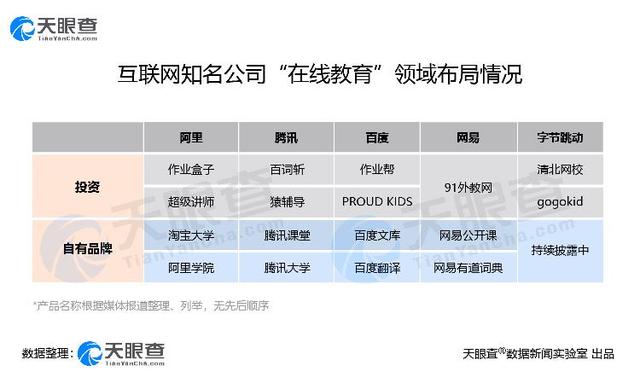
Looking at the relatively popular online education platforms in China in recent years, behind them there are more or less the figures of major internet companies, such as Zuoyebox, Baicizhan, Yuanfudao, Zuoyebang, NetEase Open Course, and others. According to a 36Kr report, Yuanfudao has completed the delivery of a new round of $1 billion in financing, led by Hillhouse Capital, with Tencent, Boyu Capital, and IDG Capital participating, making it the largest financing in the education industry to date. The layout of these internet giants in online education has also become an industry bellwether, continuously attracting new players such as Meituan and ByteDance to enter and share in the online education pie.
In recent years, the market size of China's online education industry has ushered in explosive growth. According to an iResearch report, in 2012 the market size of China's online education industry was 70.52 billion yuan, and by 2017 this figure had rapidly risen to 200.26 billion yuan, with a compound growth of 419.39% over 6 years. It is expected that by 2022, the market size of China's domestic online education will exceed 540 billion yuan.

Room 1409, Building C, Shenzhen Century Industrial Center, No. 743 Zhoushi Road, Hezhou Community, Hangcheng Sub-district, Bao'an District, Shenzhen